


SPECIAL INVESTIGATIVE REPORT: UNCOVERING THE DEEP-SEA “MONSTER POACHING” RING OFF THE GULF OF MEXICO
By the Special Investigative Reporting Team
Updated at 06:00 AM – Florida Peninsula, United States
Part 1: The Midnight Engine and Shadows on the Waterway
Late in the night of September 17 and into the early hours of September 18, a dense fog blanketed the winding creeks leading out to the open waters of southern Florida. Often referred to as a treacherous maze of mangrove swamps, this intricate network of waterways has long provided ideal cover for illicit trafficking operations seeking to evade United States Coast Guard (USCG) patrols.
At approximately 2:15 AM, an aged wooden fishing vessel, hull registered as FL-8821, quietly pulled into a secluded creek in Monroe County. The vessel ran entirely dark with no navigation lights, illuminated solely by the faint glimmers of head-mounted flashlights. Two men hurriedly unloaded a massive, heavy payload wrapped tightly in tattered tarps that reeked of ocean silt and decaying marine vegetation.
What they did not know was that every single step had been tracked through the thermal scopes of agents from the National Oceanic and Atmospheric Administration (NOAA) working alongside federal environmental police in a joint operation running over six months.
Part 2: The Face of the Abyss Revealed
At dawn, as the two suspects prepared to hoist the cargo into a refrigerated box truck stationed beside a patch of palm trees, tactical teams made their move. The sudden wail of sirens pierced the silence. Ambushed and cornered, both suspects were subdued on the pavement before they could destroy or abandon the evidence.
When the black plastic tarps were pulled back over the damp concrete path, the scene left even veteran field investigators speechless:
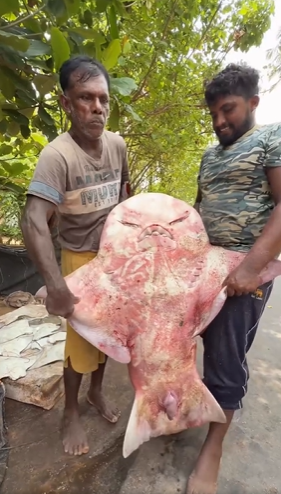
A colossal, deformed marine creature lay on the ground, slick with fluid, weighing an estimated two hundred pounds. Its wide body was flattened from side to side, its skin mottled with a pale pinkish tone overlaid with dark red patches, likely caused by severe hemorrhaging from rapid depressurization from the ocean floor. The head merged seamlessly into its broad torso, flanked by two fleshy pectoral fins spread wide like bizarre wings.
Most unsettling was the creature’s frontal anatomy, which bore an eerie resemblance to a distorted human face: two tiny, tightly closed eye slits sat above an oversized, gaping maw covered in wrinkled, folded flesh that formed a sullen, furious expression. Toward the bottom, its torso tapered into a short, stump-like caudal fin.
In order to photograph the specimen and pitch it to intermediaries across encrypted messaging apps, the poachers propped the animal upright on the dirt road. The older man, weathered with graying hair, gripped the crown of the creature’s head while the younger man held fast to the edge of its thick, fleshy fin. The resulting crime scene image carried an eerie, surreal atmosphere that sent chills down the spine.
Part 3: The Desperadoes of the High Seas
At the precinct, the suspects’ backgrounds were swiftly laid bare. The mastermind was identified as Arthur Vance (52), a Key West diver and commercial fisherman with more than 30 years at sea, previously convicted for the illegal harvest of black coral. His accomplice was Marcus Reed (34), an experienced marine mechanic.
According to surveillance files, Vance was far from an impoverished fisherman trying to scrape together a daily living. He served as a crucial node in a specialized illicit network fulfilling orders for wealthy collectors across Asia and the Middle East—buyers willing to pay anywhere from $40,000 to $70,000 for rare, deformed deep-sea specimens destined for luxury villa displays or underground culinary banquets.
To dredge up these abyssal organisms, Vance and Reed had retrofitted their trawler with heavy-duty commercial winches and deployed illegal deep-sea bottom trawling nets. The pair ventured far beyond territorial limits to drop gear along abyssal trenches exceeding 2,000 meters in depth along the outer Gulf of Mexico—a pitch-black realm of crushing hydrostatic pressure.
There, using weighted steel rigs baited with rotting chum alongside destructive drag nets, they scraped across fragile seabed sediments, leveling ancient deep-water coral systems simply to haul up freakish organisms from the deep.
Part 4: A Cry from the Ecological Abyss
That same afternoon, marine biologist Dr. Eleanor Harris from the Southeastern Marine Wildlife Institute arrived on-site to collect tissue samples and conduct an initial forensic examination.
Speaking to reporters, Dr. Harris did not hide her distress:
“Morphologically, this specimen belongs to an order of angel sharks or an exceedingly rare species of benthic anglerfish (Lophiiformes/Squatinidae). At depths of several thousand meters, hydrostatic pressures hundreds of times greater than at surface level keep their soft tissue structures intact. When hauled rapidly to the surface on high-speed winch cables, internal organs rupture and subcutaneous vessels burst from acute barotrauma—which explains its dark purplish coloring and warped, bloated shape.
These benthic organisms possess extraordinarily slow metabolic cycles; many can live for upwards of a century but reproduce at very low rates. Every single specimen taken means the permanent loss of an irreplaceable genetic lineage from our oceans.”
She added that consuming deep-sea fish meat poses grave health hazards. As apex bioaccumulators at the base of benthic food webs over several decades, their fatty tissues frequently concentrate lethal amounts of methylmercury, arsenic, and heavy metals at levels hundreds of times above safe human consumption limits.
Epilogue: Justice at the Bar
The U.S. Attorney’s Office for the Southern District of Florida has filed formal federal indictments against Arthur Vance and Marcus Reed on multiple felony counts:
- Aggravated violations of the Lacey Act regarding the unlawful trafficking of wildlife.
- Unlawful possession and harvesting of specially protected deep-sea marine fauna.
- Destruction of seabed habitats and deep-sea coral ecosystems through illegal bottom-trawling gear.
Under federal sentencing guidelines, the two face up to 15 years in federal prison and criminal fines reaching $500,000. Furthermore, their vessel, winches, and all associated tackle have been seized for federal forfeiture.
The deceased specimen has been placed in cryogenic preservation and transferred to the National Museum of Natural History for scientific dissection, educational display, and genetic cataloging.
While the case draws to a close, it serves as a stark warning: when human greed casts its drag nets into the deepest and darkest recesses of our oceans, the ultimate price paid will not only be measured in courtroom prison terms, but in the devastating ecological collapse that follows.